How to Turn Your Logo Into a Patch (Artwork Guide)
What file to send, what happens to your logo in production, which design elements survive stitching and which do not, and how to check a proof properly.
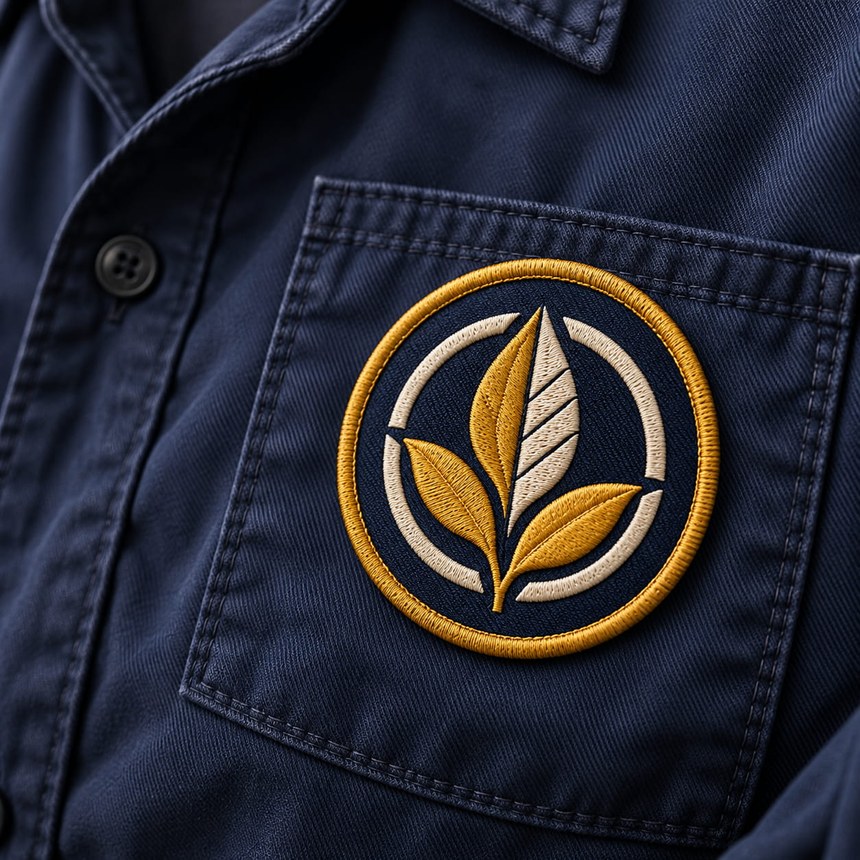
Most people assume the hard part of ordering a logo patch is having the right file. It usually is not. The real work is translation — a logo designed for screens has to become something a machine can stitch or mould, and not everything survives that journey intact.
Here is what actually happens to your logo, and what to check before you approve anything.
What file should you send?
The honest answer: whatever you have.
| What you have | How it goes |
|---|---|
| Vector (AI, EPS, PDF, SVG) | Perfect. Nothing to redraw |
| High-resolution PNG or JPG | Great. Traced cleanly |
| Screenshot or low-res image | Fine. Redrawn, you approve the result |
| Photo of a drawing on paper | Fine. Genuinely — this is common |
| A written description | Workable. We sketch, you react |
Vector is ideal because it scales without losing sharpness and the shapes are already mathematically defined. But it is not a requirement, and you should not delay an order because you cannot find the original file. Redrawing artwork is part of the service and we do not charge for it.
If you do have the vector file, send it — it removes a step and reduces the chance of a shape being interpreted slightly differently than you intended.
What happens to your logo in production
This is the part most guides skip.
Your logo is not printed onto a patch. It is rebuilt in a different medium:
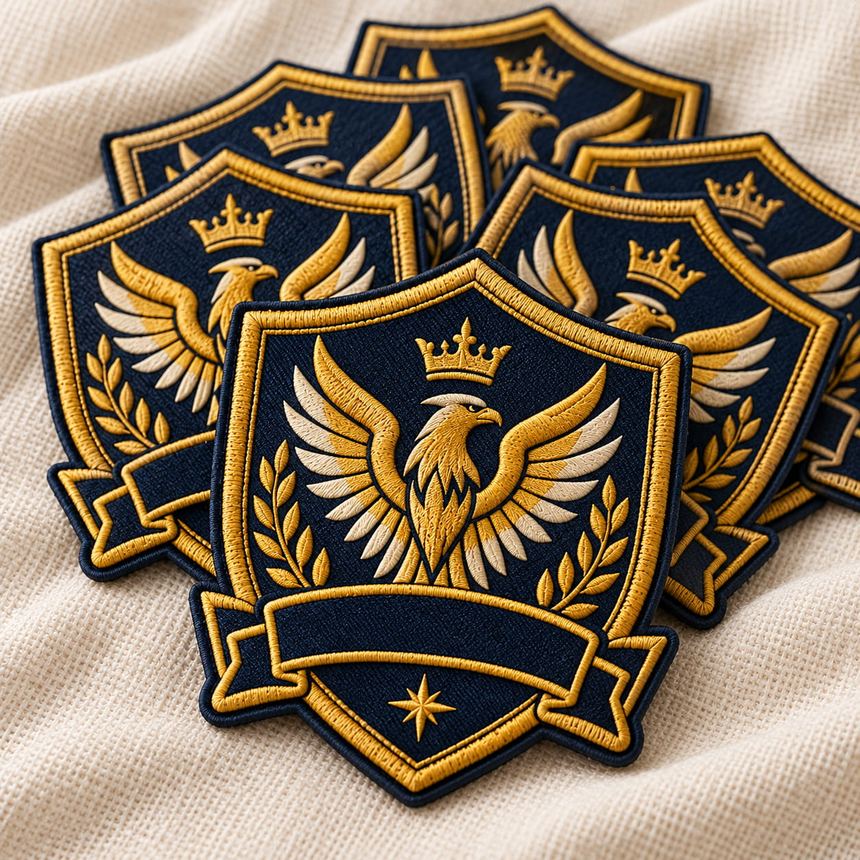
- For embroidery, it becomes a stitch file — a set of instructions telling the machine where to place each stitch, in what direction, in which colour, in what order. This is called digitising.
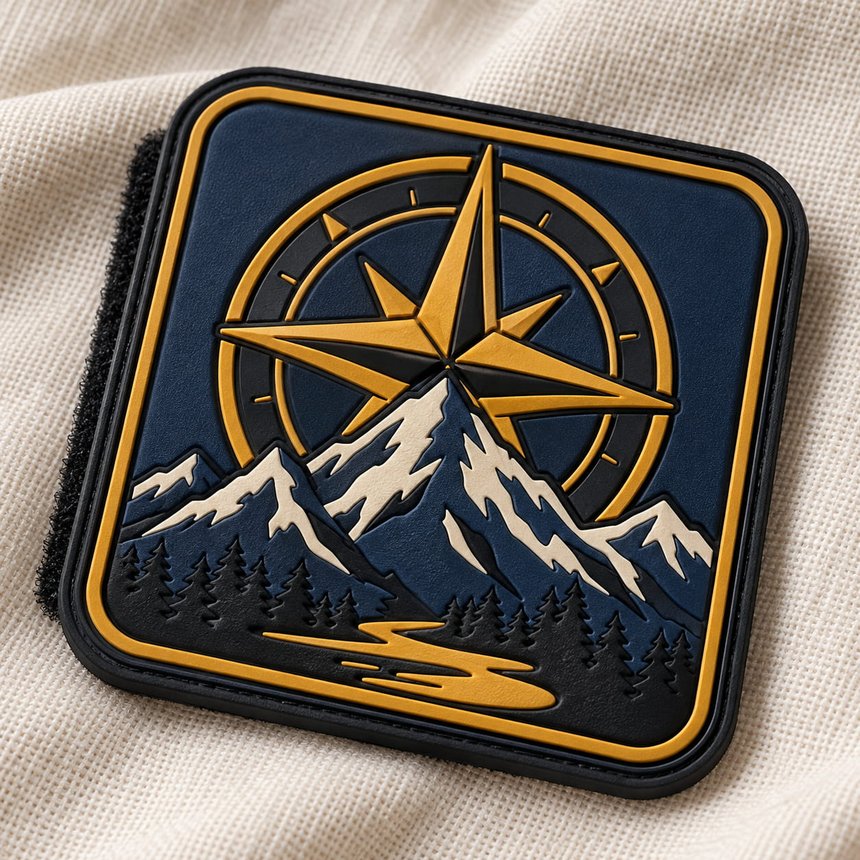
- For PVC, it becomes a mould — a physical tool with your design cut into it, at specific depths for each raised level.
In both cases, someone makes judgement calls. How thick should that thin line become? Which two of your five greys should merge? Does that gradient get approximated or simplified?
A good supplier makes those calls thoughtfully and shows you the result. That is what a proof is for.
What survives, and what does not
Survives well
- Bold shapes with clear edges
- Solid colour blocks
- Text at reasonable size — 1/4 inch tall or more for embroidery
- Simple geometric marks — circles, shields, stars, monograms
- Two to eight distinct colours
Needs adapting
- Thin lines. Embroidery has a minimum stroke width. Hairlines get thickened or dropped.
- Gradients. In embroidery, approximated by blending thread colours. In PVC, reproduced cleanly.
- Drop shadows and glows. These are screen effects. They become either a solid shape or nothing.
- Very small text. Below 1/4 inch, letters crowd and fill in. Either enlarge it or remove it.
- Photographic elements. Cannot be stitched. They have to be redrawn as flat shapes.
- Many similar tones. Five shades of blue will likely become two or three.
A useful self-test
Print your logo at the actual size you want the patch. Look at it from three feet away.
Anything you cannot make out at that distance will not read on the finished patch either. That is not a limitation of the manufacturing — it is a limitation of the design at that size.
Sizing your logo patch
Common sizes and where they go:
| Placement | Typical size |
|---|---|
| Shirt chest / polo | 2.5” – 3.5” wide |
| Cap front | 2” – 2.5” wide |
| Jacket chest | 3” – 4” wide |
| Bag or backpack | 3” – 4” wide |
| Jacket back | 8” – 12” wide |
Wider logos need more height than you think. A horizontal logo with a strapline scaled to 3 inches wide can end up with text under a sixteenth of an inch tall. Either drop the strapline, stack the elements, or go larger.
This is the most common problem with logo patches, and it is much easier to solve before production than after.
The colour matching question
Embroidery matches to the nearest available thread, from a range of around 200 shades. This is usually very close — most people cannot tell the difference — but it is a match, not an exact reproduction.
PVC can be Pantone matched almost exactly, because the colour is mixed rather than selected.
If your brand guidelines are strict, send your Pantone codes with your quote request. We will tell you honestly what to expect before anything is produced, rather than after.
One thing worth knowing: thread colour looks different depending on the base fabric. A gold thread on navy twill reads warmer than the same gold on white. Mention what the patch will sit on.
How to check a proof properly
This is where orders go right or wrong, and it takes five minutes.
1. Read every word out loud. Spelling errors in logos get approved constantly, because you have seen your own logo so many times you no longer read it. Say it aloud.
2. Check the dimensions, not just the picture. The proof shows a size. Measure that against where it is going. Hold a ruler to the garment.
3. Look at the smallest element. If there is small text or a fine line, that is what will fail. Is it clearly legible?
4. Check colour count and placement. Did anything merge that should not have? Did a shape shift?
5. Have someone else look. Genuinely the highest-value step. A second pair of eyes catches what yours skip over.
Once you approve a proof, it becomes the agreed specification. Changes after that mean a remake at your cost. Before that, revisions are free and unlimited — so be as picky as you like at this stage.
Do you own the logo?
A practical point, not a legal lecture.
We can only reproduce artwork you own or have permission to use. That means:
- Your own brand: no issue.
- A client’s brand, with their sign-off: fine — just tell us.
- A sports team, character, or brand you admire: not without written permission from the rights holder.
This protects you as much as us. A batch of patches infringing someone’s trademark is a problem that does not stop at the supplier.
Reorders
Your production file stays on record. That means a top-up order in two years matches the original exactly — same colours, same dimensions, same stitch file — with no new setup charge.
Worth knowing if you are kitting out staff who join throughout the year.
Quick checklist
- Best available file located (vector if you have it)
- Logo printed at actual size and checked from three feet
- Smallest text measured — at least 1/4 inch for embroidery
- Pantone codes gathered if colour accuracy matters
- Garment colour noted
- Rights to the artwork confirmed
- A second person lined up to check the proof
Send us your logo and we will tell you how it will translate — including if we think a different size or technique would serve it better. Request a free quote. Free artwork setup, free digital proof, unlimited revisions, nothing owed until you approve.
Read more about custom logo patches.